Material: Painted wood
Looking towards a vertex, a parallel projection of a cube results in a hexagon. The front and back vertices of the cube end up superimposed at the center of this hexagon. The square faces of the cube are projected into the interior of the hexagon – they become two layers of overlaying rhombs, three in the 'front' and three in the 'back'. The front and back vertices of the cube end up superimposed at the center of the hexagon.
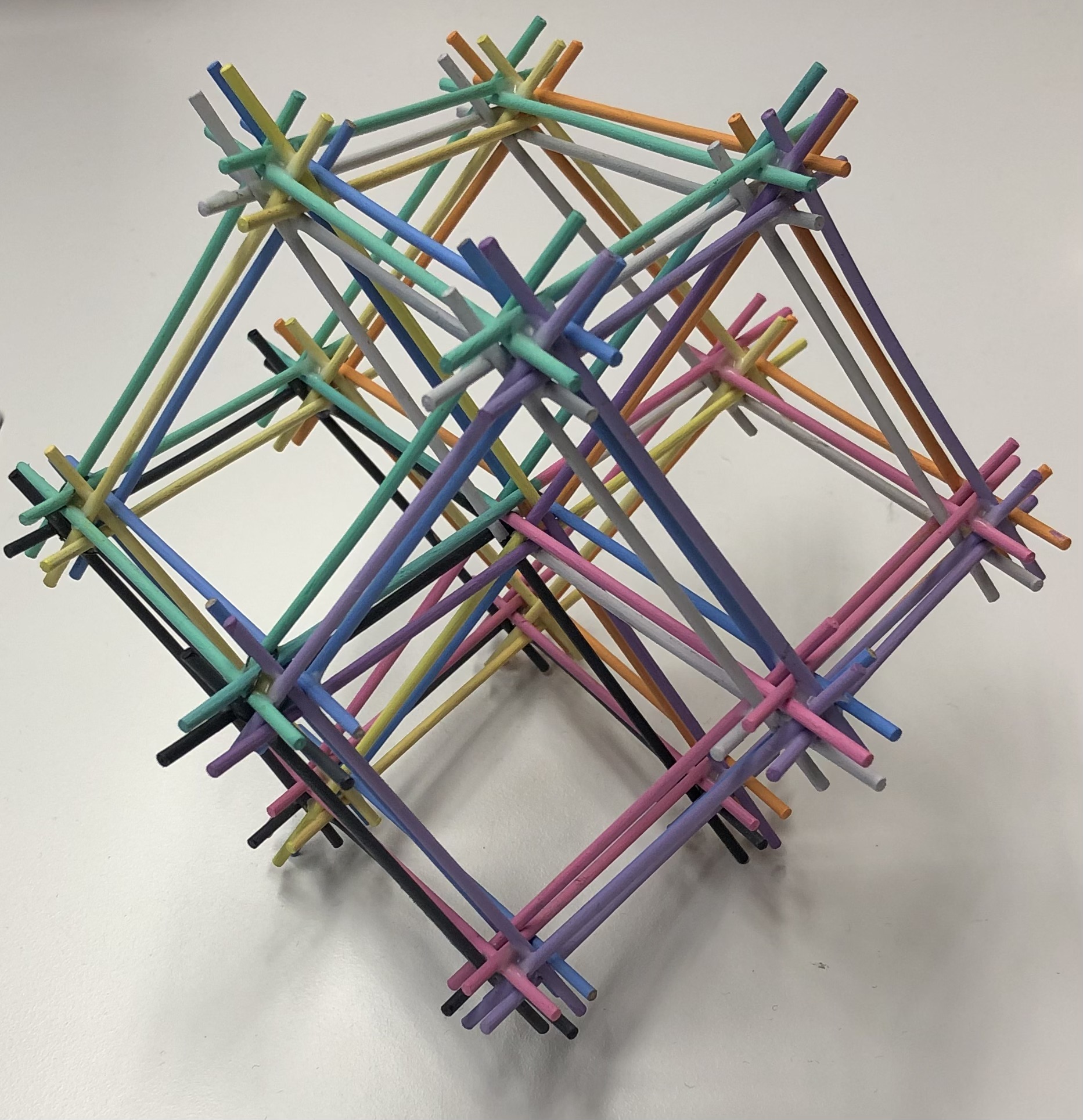
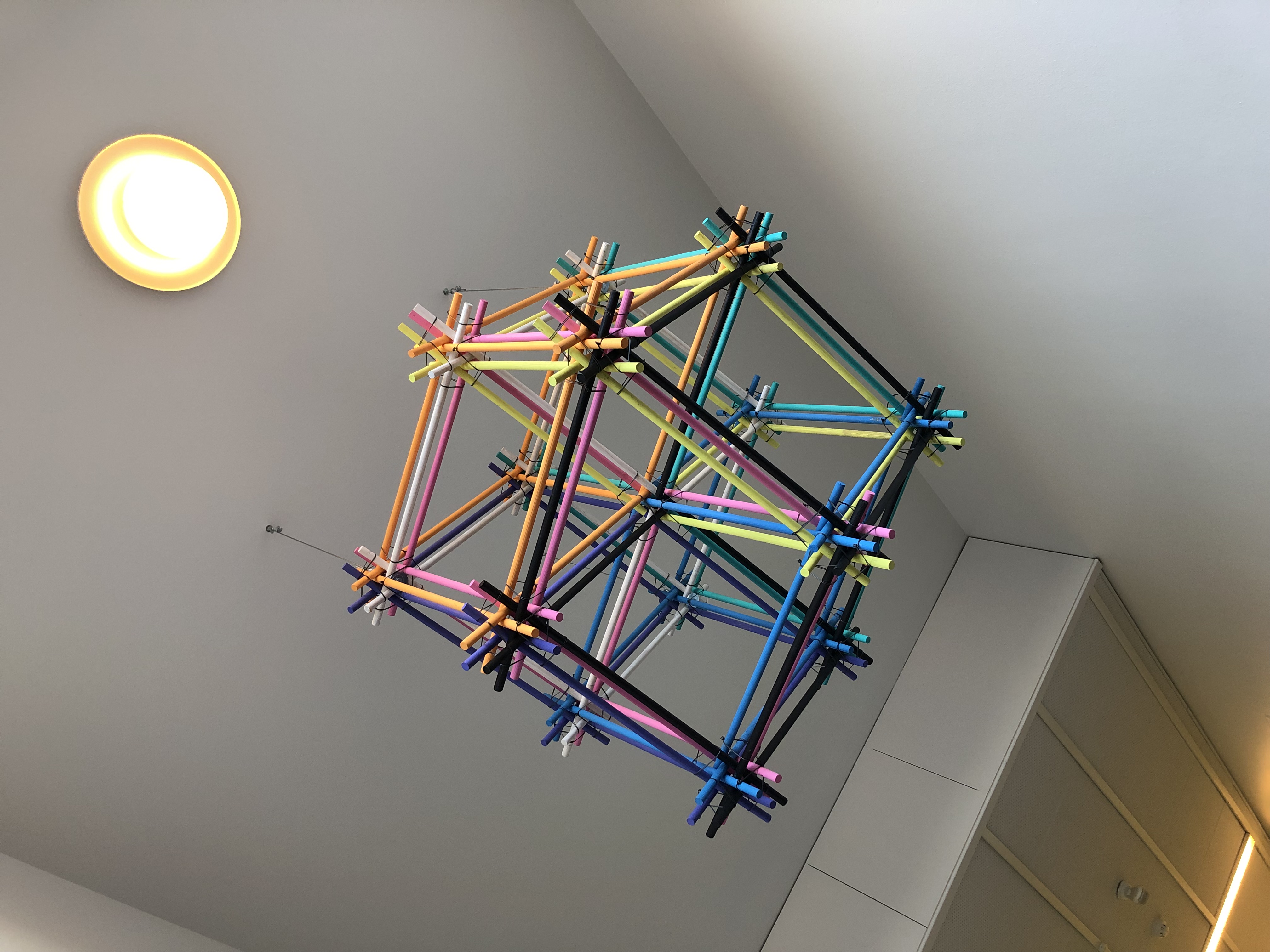
Similar phenomenon can be observed when portraying the tesseract in 3D space using analogous parallel projection method. It results in a rhombic dodecahedron, and the front and back vertices of the tesseract end up superimposed at the center of this rhombic dodecahedron. The cubic cells of the tesseract are projected into the interior of the rhombic dodecahedron – they become two layers of overlaying pyramids with rhombic bases. There are four of such pyramids in the 'front' and four in the 'back'.
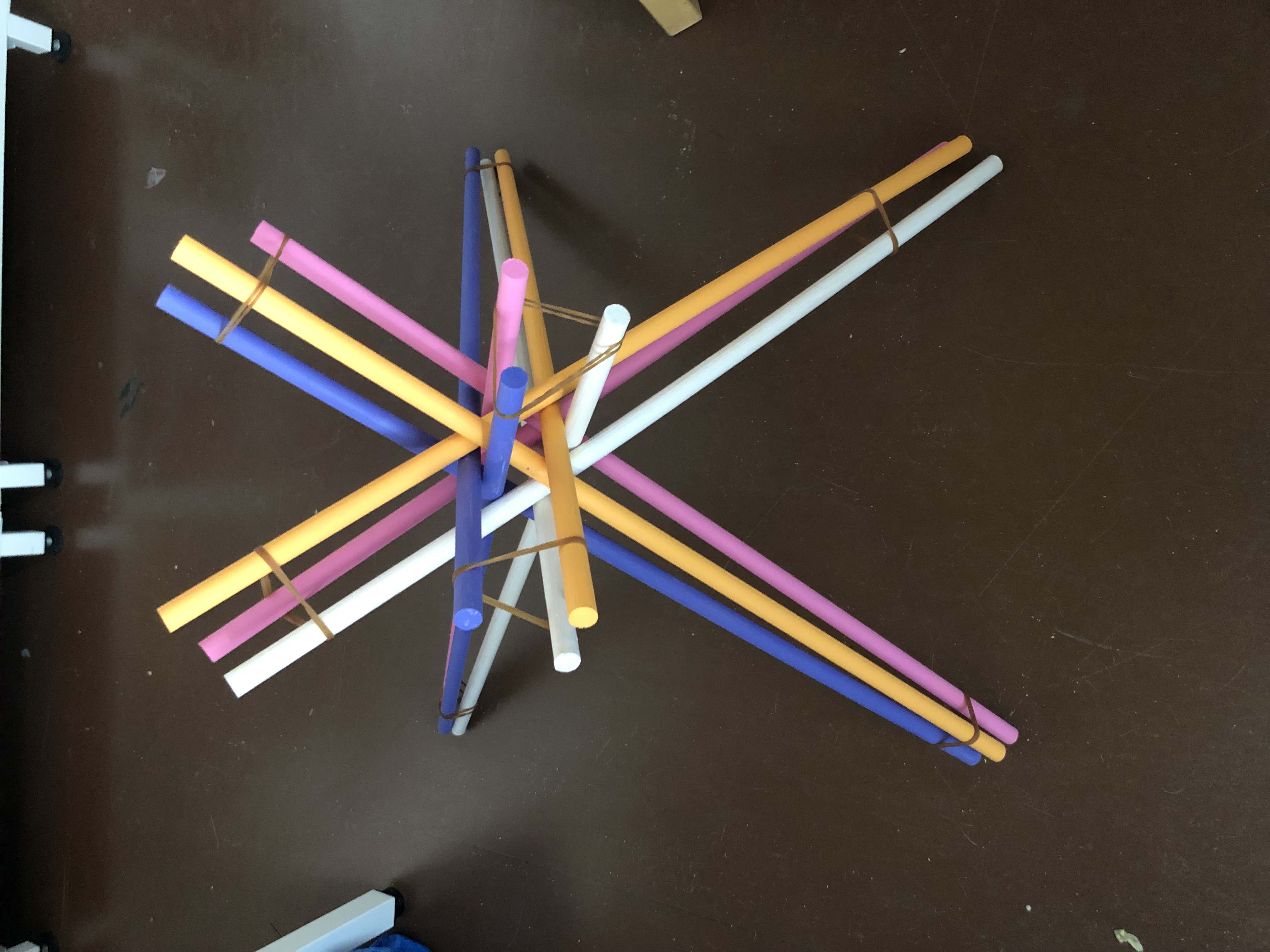
The edges of the piece Eight Cubes are made of three rods each, reflecting how there are three cubes meeting on each edge of the tesseract. At the vertices the rods are weaved together in a burr puzzle type of arrangement, also called the hexastix. This structure makes it possible to illuminate each of the cubes of the tesseract with its own color, and thus each face, edge and vertex gets an unique 2-, 3-, and 4-coloring, respectively.