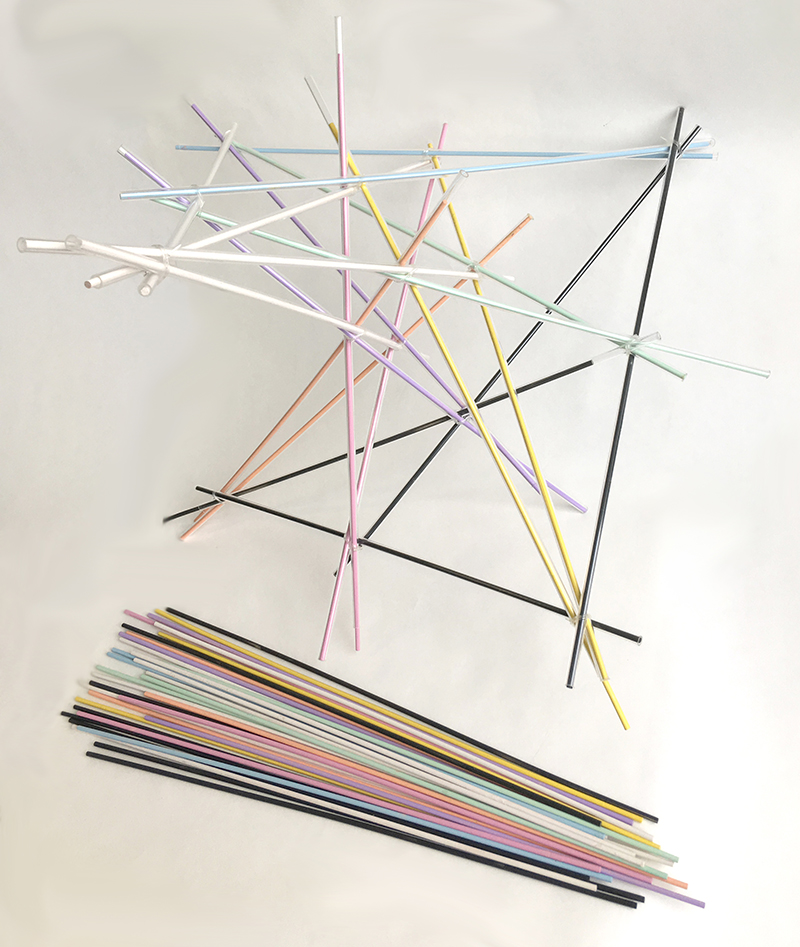
Materials: 20 acrylic tubes, 38 painted wooden dowels
When a five-dimensional structure called the expanded five-simplex is projected from its center down to a lower space, it yields an elegant configuration of 15 points, 20 lines, and 15 planes, and 6 hyperplanes (three-dimensional spaces). Each of its points is an intersection of 4 lines, 6 planes, and 4 hyperplanes, and each line goes through 3 points, and is an intersection of 3 planes and 3 hyperplanes. Each of its planes goes through 6 points, 4 lines, and is an intersection of 2 hyperplanes. Each of its hyperplanes goes through 10 points, 10 lines, and 5 planes.
The Perspectorial portrays a higher-dimensional generalization of the renowned Desargues configuration in perspective drawing, and embodies a higher analog of his theorem: If two tetrahedra – with opposite edges having complementary colors (blue/orange, red/green, yellow/purple), are in perspective from a point (white), then the intersections of the corresponding edges are coplanar (black). There are 15 different instances of such perspectivity in the configuration, and the model built from clear tubes allows the illumination of each of them by the insertion of painted dowels.
By building this model, I noticed also that if the three centers of perspectivity determined by three triangles are collinear, then the intersections of the corresponding edges are collinear as well. This is another theorem that can be demonstrated with the model – in 20 different ways.
Building instructions available online at:
http://matharts.aalto.fi/workshops.html
Read more at:
http://archive.bridgesmathart.org/2018/bridges2018-559.html