Materials: Brass, steel wire
In the stereographic projection, the polytope is first inflated to a sphere, then projected from the north pole down to a picture plane tangent to the sphere at the south pole. Stereographic projection preserves the angles but bends the edges to curves.
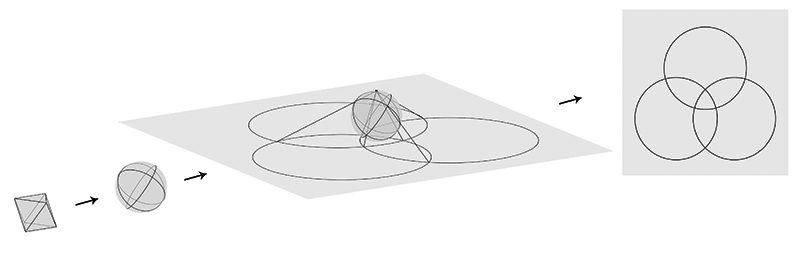
Stereographic projection of the octahedron (6 vertices, 12 edges, and 8 triangular faces) produces three circles on the picture plane, intersecting at right angles at six vertices. If the octahedron is rotated under the projection, these circles will exchange their places.
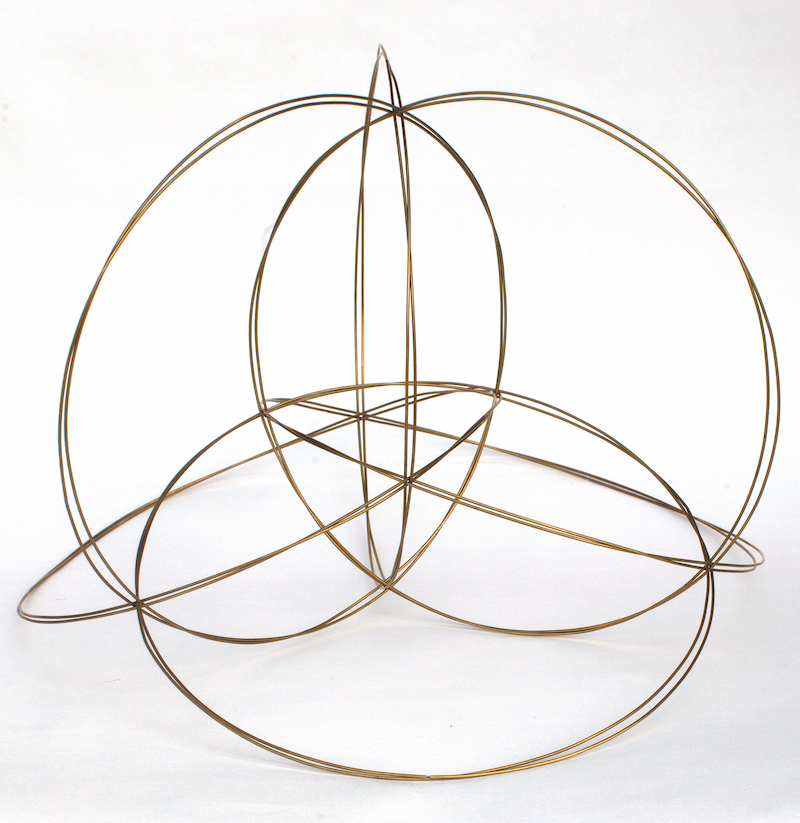
Stereographic projection of the 4-dimensional solid called the hexadecachoron (8 vertices, 24 edges, 32 triangular faces, 16 tetrahedral cells) produces four spheres on the picture space, intersecting at right angles along six circles and at eight vertices.
The Kinochoron is manipulable stereographic projection of the hexadecachoron. Its kinetic structure permits a manipulation corresponding to the rotations of the hexadecachoron under stereographic projection, and the circles can exchange their places in the structure. When all 12 hoops are pushed together, the model collapses flat for easy transport.
Read more at: https://archive.bridgesmathart.org/2014/bridges2014-191.html